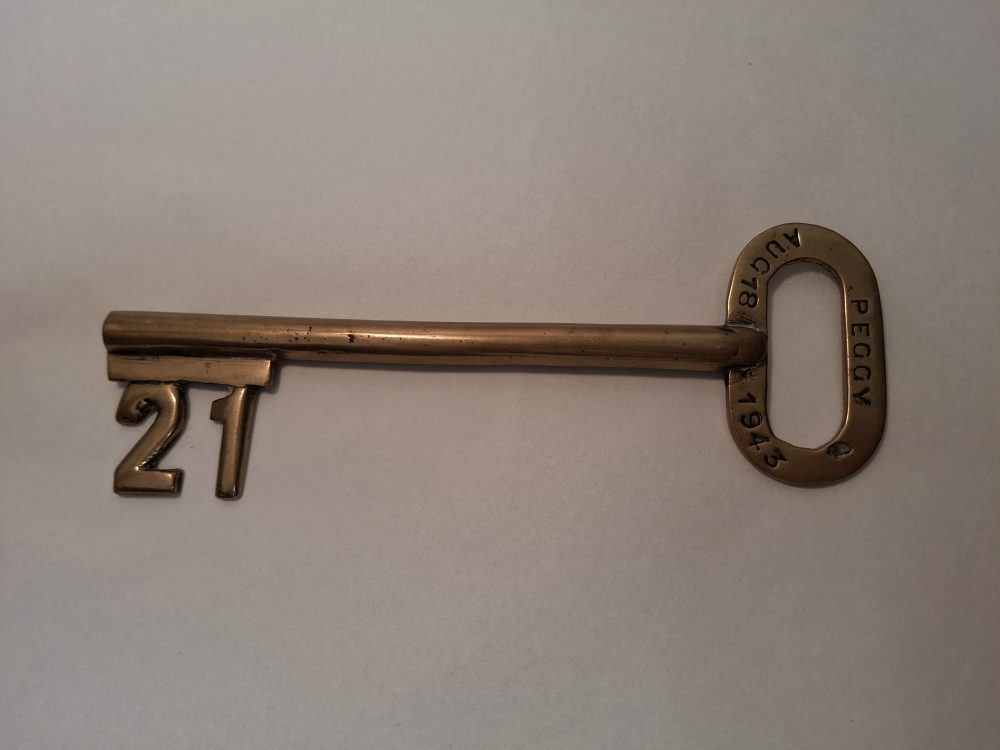
April 2026: Brass 21st Birthday Key
April’s Object of the Month is a commemorative 21st birthday key from 1943. It belonged to Peggy Perring and was given to her on her birthday on 18th August. Gordon Crocker (whom Peggy would go on to marry) organised for the key to be cast in the foundry at Swindon Works. Although this was technically not permitted, it was standard practice. The key is a reminder of women’s work in GWR and of birthday traditions.
Peggy was born in Dartmouth in 1922. By the time she was 19 she was required to register for war work, which she took in Swindon. Despite employing women in other departments – as cleaners from the 1860s and in the carriage works from 1874 – GWR was slow to employ women for war work, particularly in the Locomotive Department. However, it had to meet targets set by the Ministry of War Transport for the maintenance and production of rolling stock. This demand was an incentive to employ women and in 1941 a Women’s Welfare Supervisor was appointed to promote women’s spaces at work. By 1943 more than 16,000 women were employed across the GWR.
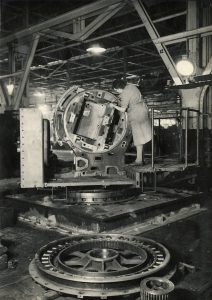
A woman working on gun casing in AM shop in 1942.
Peggy worked in the AM shop. Ordinarily this was the machine shop, but in war time Swindon Works produced bombs, submarines, landing craft, and artillery. The Works provided roughly 60,000 bombs throughout the war and the AM shop was dedicated to munitions. Peggy was not permitted to wear makeup to work and had her eyebrows rubbed to check for it. By the end of the war, Peggy had moved back to Dartmouth.
While working here, she made several lifelong friends and met Gordon Crocker, who had followed his father into work in the AM shop. Peggy and Gordon married in Totnes in 1945.
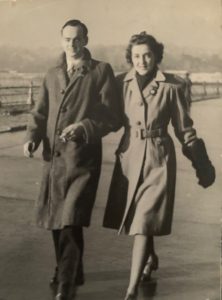
Peggy and Gordon in the 1940s
As well as telling us about women in the Swindon Works, this key is a reminder of birthday traditions. Before the Family Law Reform Act and The Representation of the People Act 1969, the age of majority was 21. This was also the age that you could legally marry without a parent’s consent. As such, a 21st birthday marked independence and was celebrated more than other birthdays. Originally, children were given keys to symbolise their freedom to come and go from their parent’s house. This evolved into a tradition of key-giving – people might receive a commemorative metal key, like Peggy, or even wooden replicas. Keys were also a common feature on 21st birthday postcards.
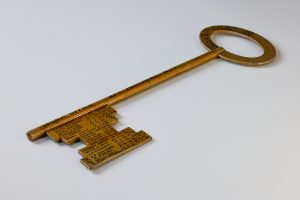
A large wooden 21st Birthday key from STEAM’s collection. It came from the Swindon Work Order Office and was given to members of staff between 1943 and 1968.
Jenna Brooks – Collections Volunteer


